
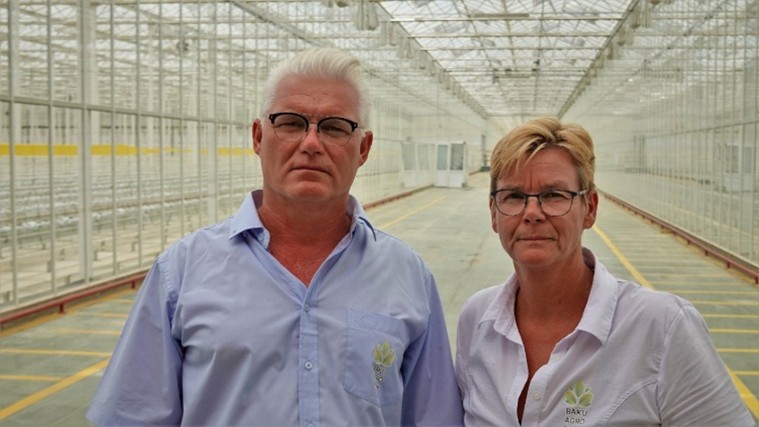
 From August 2018 to May 2020, we played a key role in the development and professionalization of the Baku Agro Park greenhouse complex in Azerbaijan. The project, initially spanning 10 hectares, expanded to 20 hectares under our guidance, specializing in premium Pink Beef tomatoes and mid-sized cluster tomatoes primarily for the Russian export market.
Upon arrival, we immediately focused on optimizing operations. We reorganized the labor structure, creating specialized teams for twisting, pruning, and harvesting, each led by trained team leaders. This restructuring boosted work quality, speed, and efficiency. As the second phase launched, local labor managers were successfully trained and equipped with planning and control systems based on weekly, monthly, and annual data.
Climate management saw significant improvements with the use of the Priva climate computer. We achieved remarkable reductions in gas consumption by optimizing heating strategies—lowering minimum and maximum pipe temperatures and reducing heating during low-light periods—while maintaining excellent plant balance through a radical new pruning strategy tailored for year-round production.
Crop nutrition was revolutionized with the introduction of the Van Iperen calculation program, allowing precise feeding schedules, substantial fertilizer savings, and effective water recycling. We also developed a comprehensive grow plan, ensuring proper plant balance even through the challenging low-light winter season.
Integrated Pest Management (IPM) became a major success story. Initially reliant on chemical control, we introduced biological methods, becoming the first greenhouse operation in Azerbaijan to fully implement IPM practices, significantly reducing chemical usage and contributing valuable knowledge to the local agricultural sector.
Other key innovations included:
- Introduction of structured bumblebee hive planning for optimal pollination.
- Development of detailed grow budgets and quality dashboards for improved forecasting and benchmarking.
- Establishment of solid production data systems, enabling full local management control after two seasons.
Thanks to increased yields, improved product quality, and significant cost reductions, we also helped negotiate better working conditions for the staff, setting a new standard for greenhouse operations in the region.